Definitions

(verb) to leave; to part from; to be away from
(preposition) from; distance from
(preposition) without; independent of

Etymology

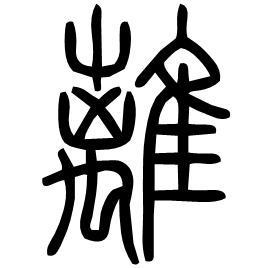
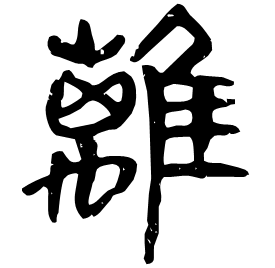
Pictograph of a legendary mountain demon with horns and a tail beween its legs, now written as . The traditional character (leave; depart; away from) was simplified to by deleting the (bird) component.

About

The traditional character "離" structurally integrates the component "隹" denoting a bird with "离" acting as a phonetic element, originally conveying the idea of a bird being entangled or separated. Over centuries, its meaning generalized from this specific imagery to express the broader actions of departing, leaving, or becoming distant. The simplified form "离" retains the phonetic component while discarding the avian "隹", yet it continues to encode the core semantic notions of separation and departure inherited from its traditional counterpart.

Etymology Hide

Seal etymology image
Seal Shuowen (~100 AD)
Clerical etymology image
Clerical Qin dynasty (221-206 BC)
Traditional Modern
Simplified Modern

Example Sentences Hide

开家的时候要锁门。

Lí kāi jiā de shí hòu yào suǒ mén.

Remember to lock the door when you leave home.

火车站这儿很近。

Huǒ chē zhàn lí zhèr hěn jìn.

The train station is very close to here.

请不要远你的父母。

Qǐng bù yào yuǎn lí nǐ de fù mǔ.

Please don't wander far from your parents.

他的办公室我的很近。

Tā de bàn gōng shì lí wǒ de hěn jìn.

His office is very close to mine.

我们不得不暂时分

Wǒ men bù dé bù zàn shí fēn lí.

We have to be separated for a while.

婚是一个艰难的决定。

Lí hūn shì yí gè jiān nán de jué dìng.

Divorce is a difficult decision.

他的观点脱了实际情况。

Tā de guān diǎn tuō lí le shí jì qíng kuàng.

His viewpoint has deviated from the actual situation.

两国文化之间存在很大距

Liǎng guó wén huà zhī jiān cún zài hěn dà jù lí.

There is a great distance between the cultures of the two countries.